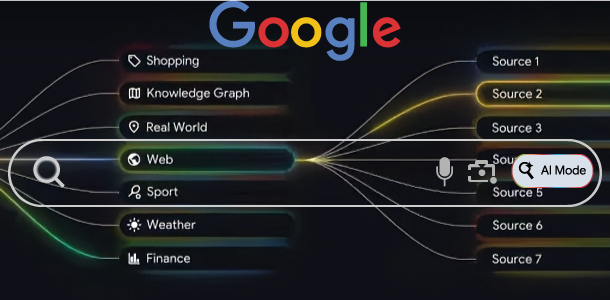
You may have noticed some big changes in how Google presents search results lately. What you’re seeing is the new Google AI Mode, a smarter way of finding information powered by a process called the Query Fan-Out technique. This isn’t just a small update; it’s a fundamental shift in how search works, moving beyond a simple list of links to providing direct, comprehensive answers. This new method changes the game for both everyday users and website owners.
Video Tutorial: Query Fan-Out Technique Simplified
What Exactly is Query Fan-Out?
Think about the last time you had a complicated question that required multiple searches. Maybe you were planning a trip and had to search for flights, then hotels, then local weather, and then things to do on your holiday. The Query Fan-Out technique aims to eliminate that hassle.
As the name suggests, when you ask a complex, multi-part question, Google’s AI “fans out” your query. It intelligently breaks your single big question down into several smaller, logical sub-queries. It then sends these sub-queries to different, specialized information systems simultaneously.
An Example in Action

Let’s use the example from the image. A user asks, “when is the best time this week to schedule an outdoor engagement photoshoot in the boston public garden?”
A traditional search might just show you articles about “best time for outdoor photos” or the Boston Public Garden’s website. Google’s AI Mode does much more. It breaks the query down:
- What light do photographers prefer for outdoor shoots? (Sent to the Web/Image system)
- When is the best time to take outdoor photos (Sent to the Web system)
- What’s this week local forecast and how cold will it be? (Sent to the Real World/Maps and Weather system)
- Where is the Boston Public Garden? (Sent to the Real World/Maps and Knowledge Graph)

After gathering all this information, the AI synthesizes it into one complete, easy-to-understand answer. You get the ideal day, time, and location advice all at once, without needing to perform several separate searches.
How This Changes the Search Experience for Users
For the typical searcher, this is a massive quality-of-life improvement. The biggest benefit is getting answers to complex, conversational questions much faster. You can ask Google things in the same way you’d ask a person and receive a well-rounded response.
- You get faster, more direct answers
- There is less need to click through multiple websites
- It’s better at handling long and complicated questions
- The search results feel more like a conversation
The Importance for Website Owners and SEOs
While great for users, Google AI Mode presents new challenges and opportunities for anyone who runs a website or works in SEO. The familiar “10 blue links” are no longer the main focus. The new goal is to become one of the trusted sources the AI uses to build its answers.
Your New Goal is to Be the Source
In the past, the aim for most SEOs or website owners was to rank number one for a keyword or keyphrase. Now, the objective is for your content (everything within HTML) to be so good that Google’s AI selects it as a source for its synthesized answer. When your site is cited in an AI Overview, it positions you as an authority.
That is of course if you weren’t following RankYa tutorials, because for the past couple of years I’ve been telling my long term followers to focus on building authority website and target keywords differently. If you’re new to RankYa Google and Website optimization mastery tutorials, now is a great time to learn with me. Follow RankYa on YouTube.
Topical Authority is Now Critical
Since the AI pulls information from various places to create a complete picture, websites that cover a topic comprehensively will be favored over general type of websites (in mid-level or highly competitive industries that is). Instead of writing one short article on a single keyword, you should aim to build a cluster of content that answers many related questions about your subject.
Prove to Google that you are an expert in your niche. On a website that is mobile friendly, loads fast without any Core Web Vital issues, and has original useful content.
The Role of Structured Data
Structured Data which Google recommends is more important than ever. This code helps search engines understand the context of your content without ambiguity. If you run a recipe site, Schema tells Google exactly where the ingredients, cooking time, and calorie counts are. This makes it easier for the AI to pull your data accurately and present it in its answers.
How to Adapt Your SEO Strategy for Google’s AI Mode
The core principles of good SEO still apply, but with a renewed focus. High-quality, original, user-focused content wins in AI Mode. Here are a few key actions to take:
- Answer Questions Thoroughly Create content that directly answers the questions your audience is asking. Use FAQ sections when appropriate and write in a clear, straightforward manner.
- Focus on E-E-A-T Expertise, Experience, Authoritativeness, and Trustworthiness are critical signals. The AI will prioritize content from sources it deems credible.
- Embrace Long-Tail Keywords Optimize for longer, more conversational search queries that mimic how people actually speak and ask questions.
- Anticipate Complimentary Keywords Extend your target keywords to include complimentary search queries and create content accordingly.
- Implement Structured Data Use Schema.org markup to clearly define the entities and information on your pages. This gives the AI confidence in your data.
At the end of the day (or at the beginning of new Internet Search era of tomorrows), the rise of Google AI Mode using the Query Fan-Out technique algorithm is a push by Google towards more helpful and meaningful content that is delivered promptly. By focusing on becoming a true authority and providing real value to users, you can ensure your website remains visible and relevant in this new era of search.
Want to dominate AI features in Google? Here’s the latest blog post for ranking higher in Google AI Mode